Oct 02, 2026
Simulator builders often want the freedom to change their racing seat without rebuilding the entire cockpit. A seat may come from a dedicated sim-racing brand, a modified car interior, or a motorsport-style manufacturer, while the simulator itself may use steel tubing or 8020 aluminum profiles.
This is where a Universal Simulator Racing Seat becomes particularly interesting. The word “universal” sounds straightforward, but real compatibility depends on mounting patterns, seat construction, bracket dimensions, and the adjustment range available between the seat and cockpit.
Seat compatibility starts with the mounting interface. A side-mount bucket seat and a reclining automotive seat can require completely different hardware.
Universal bracket systems therefore tend to specify the seat types they support rather than claiming compatibility with every possible design. For example, SimXPro's universal mount supports side-mount seats with 220–310 mm mounting-hole spacing, while other systems target wider categories of aftermarket racing seats.
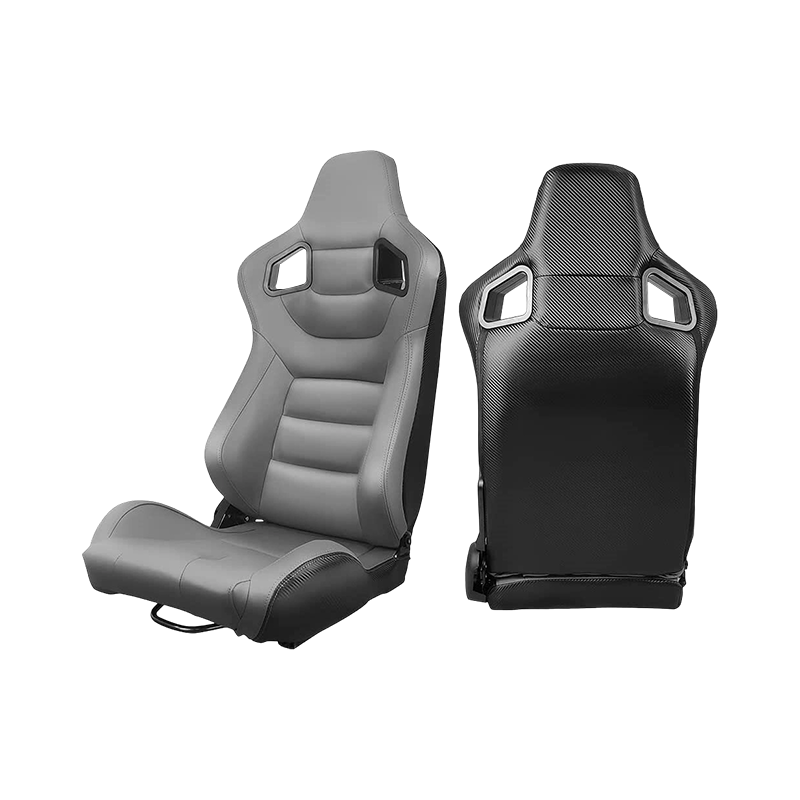
A seat can look compatible with a simulator while still failing at the mounting stage. The distance between holes is often the measurement that determines whether the parts can be connected directly.
| Measurement | What It Determines | Why It Matters |
| Side-mount spacing | Bracket-to-seat connection | Determines whether side brackets can reach the seat holes |
| Front-to-rear hole spacing | Seat position and rake | Provides different mounting angles or positions |
| Bracket width | Distance between mounting sides | Must match the cockpit crossbars or profile frame |
| Base hole pattern | Bracket-to-cockpit connection | Affects compatibility with different simulator frames |
| Hole diameter | Bolt and hardware selection | Needs to match the mounting hardware |
Current universal seat mounts illustrate how specific these measurements can be. One system supports side-mount seats across a 220–310 mm hole-spacing range, while another universal bracket uses adjustable slots to accommodate different seat widths and cockpit configurations.
Many modern simulator cockpits use aluminum extrusion because the profile system allows components to slide along T-slots. This creates additional positioning flexibility compared with a fixed tubular frame.
A universal seat bracket can take advantage of that structure. The bracket connects the seat to the extrusion frame, while the T-slot hardware allows the mounting position to move along the profile.
Some universal seat brackets are specifically designed to work with 8020-style aluminum cockpits. Next Level Racing, for example, states that its universal brackets can connect to suitable third-party 8020 aluminum-profile cockpits, while the base slots provide width adjustment.
Fixed holes provide a limited number of mounting positions. Long slots offer continuous or semi-continuous adjustment across a larger range.
One current universal bracket system provides 84 adjustment options across parameters such as height, width, angle, and tilt.
A Universal Simulator Racing Seat does not necessarily need to be bolted permanently into one location. Seat sliders can be installed between the seat and cockpit to provide forward and backward movement.
This can be particularly useful in shared simulator environments. Different drivers may have different leg lengths, so the seat needs to move without changing the position of the entire cockpit.
Universal mounting systems can also be combined with sliders. SimXPro, for example, specifies that its universal seat mount can work alongside a separate universal seat slider.
Another compatibility issue comes from the seat's physical design. A fixed-back bucket seat normally expects side brackets, while a reclining automotive seat may depend on under-seat mounting points.
| Seat Type | Common Mounting Method | Useful Hardware |
| Fixed bucket seat | Side mount | Adjustable side brackets |
| GT-style racing seat | Side or bottom mount | Side brackets or base plates |
| Reclining car seat | Bottom mount / factory rails | Under-seat universal brackets |
| Office-style seat | Base mount | Dedicated mounting adapter |
Trak Racer currently offers universal bracket systems aimed at reclining seats, office chairs, and car seats with under-seat mounting points, showing why “universal” hardware needs to be matched to the actual seat construction.
More adjustment can make a bracket useful across a wider range of setups, but the adjustment directions matter more than a single large number.
Some current universal brackets provide around 22 degrees of backward angle adjustment and 108 mm of vertical adjustment, demonstrating how a mounting system can provide substantial seating-position flexibility without altering the seat shell itself.
A universal seat system can simplify simulator upgrades, but measurements should still be checked before purchasing hardware.
Real-world simulator users also report that mounting-hole spacing can prevent an apparently suitable car seat from fitting a bracket without an adapter or a different mounting arrangement.
The answer depends less on the word “universal” and more on the interface between the components. A Universal Simulator Racing Seat paired with an adjustable bracket can potentially move between different aluminum-profile or tubular simulator frames, provided the mounting dimensions and seat type are compatible.
This approach can also extend the useful life of a simulator. Instead of replacing the entire cockpit after changing seats, users may only need a different bracket, adapter, or slider.
A Universal Simulator Racing Seat is not defined simply by having a generic shape. Its flexibility comes from the mounting interface, hole pattern, bracket slots, adjustment range, and compatibility with different cockpit structures.
That makes dimensional design particularly important. A seat with 220–310 mm side-mount compatibility, a bracket with multiple slots, or a system designed around 8020 aluminum profiles can accommodate a broader range of simulator configurations than a fixed mounting solution.
For simulator builders, the real question is therefore not “Is this seat universal?” but “Which dimensions and mounting interfaces make it universal?” Once those specifications are clear, switching between racing seats, modifying cockpit geometry, or adapting a new simulator platform becomes a much more manageable engineering task.
Hot Products

If you are interested in our products, please consult us!
contact us
E-mail: [email protected]
Tel: +86-577 6681 1072+86-577 6556 8920
WeChat / WhatsApp: +86-139 5884 2868
Add: Jiangnan Avenue Economic Development Zone, Nanbin Street, Ruian, zhejiang, China.
Copyright © by Ruian JIABEIR Auto Parts Co., Ltd. Rights Reserved.
Car Seats Manufacturer & Custom Modified Car Seats


 English
 русский
 Español
 Português